
- Home
- Project overview
- Negative emissions
- Cambodia & Vietnam: Biochar-based fertilizers from rice husks
- South Africa: Industrial Biochar and regenerative Fertiliser
- Tanzania: Industrial production of biochar
- Nepal: biochar for the reutilisation of completely depleted soils
- Namibia: Industrial biochar production from encroaching bushes
- Kenya: Direct Air Capture
- Brazil: Enhanced Rock Weathering on citrus orchards
- Ghana: Distributed Biochar Production in Smallholder Farms
- Tanzania: Industrial biochar production from coconut wood waste on the island of Mafia
- Ghana: Distributed Biochar Production in Smallholder Farms

Ghana: Distributed Biochar Production in Smallholder Farms
Women farmers producing biochar in Tamale during the pilot phase
Women farmers after biochar production in Yendi
Farmer during the pilot phase in Tamale
Implementation phase: biochar production in Tolon
Women farmers with bags of biochar in Tamale
Crane to lift the kilns
Women farmers after biochar production in Tamale
Implementation phase: biochar production in Tolon
Farmers collecting and preparing the residual biomass for biochar production
Comparison of biochar: on the left made with open air soil pits, on the right with Earth Kilns
Biochar
Manufacturing site of the Earth Kilns in Yendi
Manufacturing site of the Earth Kilns in Yendi
Official emission testing with Ithaka institute: comparison of open air soil pit vs hooded Earth Kilns
Summary
| Total savings : | Approx. 30,000 tonnes per year |
| Technology transfer : | Locally adapted pyrolysis units (hooded"Earth Kilns") that convert crop residues into biochar while improving safety and efficiency |
| Local environment : | Enhanced soil fertility through biochar application, reduced greenhouse gas emissions, and mitigation of biomass burning and decomposition. |
| Further advantages : | Creation of local jobs, promotion of circular farming models, and direct economic empowerment of women farmers. |
| Target group : | Smallholder farmers in rural Ghana |
| Financed by : | atmosfair |
| Project partners : | Carboneers |
atmosfair has deployed small-scale pyrolysis units across rural Ghana, starting in the Volta, Oti, and Ashanti region and expanding in the Northern Region. These units produce biochar far more efficiently than traditional open-air soil pits – simple pits previously used to carbonize agricultural residues. In partnership with Carboneers, atmosfair has developed steel hoods designed to cover the pits, transforming them into functional pyrolysis units: hooded “Earth Kilns”. Additionally, movable cranes help lift the combustion hood safely and easily. Following months of on-site testing and design improvements, this technology was rolled out to approximately 300 farmer groups. Smallholder farmers use it to convert cocoa pods, cassava, and other crop residues into biochar. The initiative is expected to remove about 20,000tons of CO₂ from the atmosphere annually. A further 300 kilns will start being deployed, increasing the potential savings to 30,000 CO₂e/year in 2026 and 40,000 CO₂e/year in 2027– equivalent to the emissions from over 24,000 intercontinental flights.
From Agriculture Residues to Biochar
The hooded Earth Kilns are a simple but effective solution. A steel hood covers a soil pit, enabling clean pyrolysis of local crop residues. Temperatures of up to 700°C ensure that the biomass is carbonized efficiently and with minimal emissions. Compared to open pits, the system produces far less smoke and significantly reduces methane emissions. Daps Abimbola from atmosfair’s local partner Beyond Karbon explains: “The metal hood protects people while the pyrolysis takes place underneath. It prevents them from inhaling toxic smoke, which is common with traditional soil pits. The new pyrolysis units also eliminate risks associated with open fires”
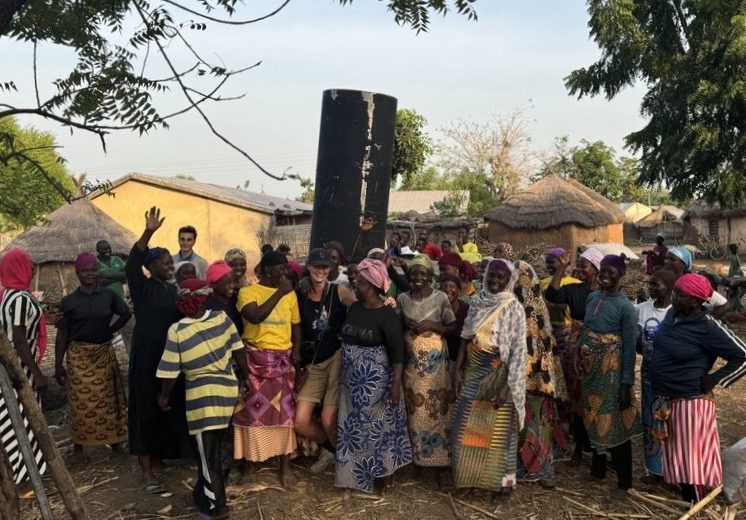
Each kiln serves a group of 15 to 20 smallholder farmers. After pyrolysis, the biochar is cooled and enriched before farmer apply it directly to their own fields to enhance soil fertility. In addition, the farmers receive payment for biochar production, providing the farmer group with an additional source of income, particularly during periods without harvest. The project prioritizes the employment of women farmers, contributing to their economic empowerment through paid work and increased participation in local value chains. The project further creates jobs in logistics, coordination, and quality control.
Fertile Soil for Improved Harvests
Biochar is applied directly in the farmers fields, usually mixed with compost or manure. It improves the soil’s ability to retain water and nutrients, particularly important in northern Ghana, where soils are often dry and depleted. Farmers report higher yields and healthier crops, while relying less on expensive chemical fertilisers.
By binding nutrients and preventing them from leaching away, biochar supports sustainable agriculture and strengthens food security – one of the core Sustainable Development Goals. The carbon-rich material remains stable in the soil for centuries, restoring fertility and building long-term resilience against erosion and drought.
Continuous Improvement Through Community Engagement
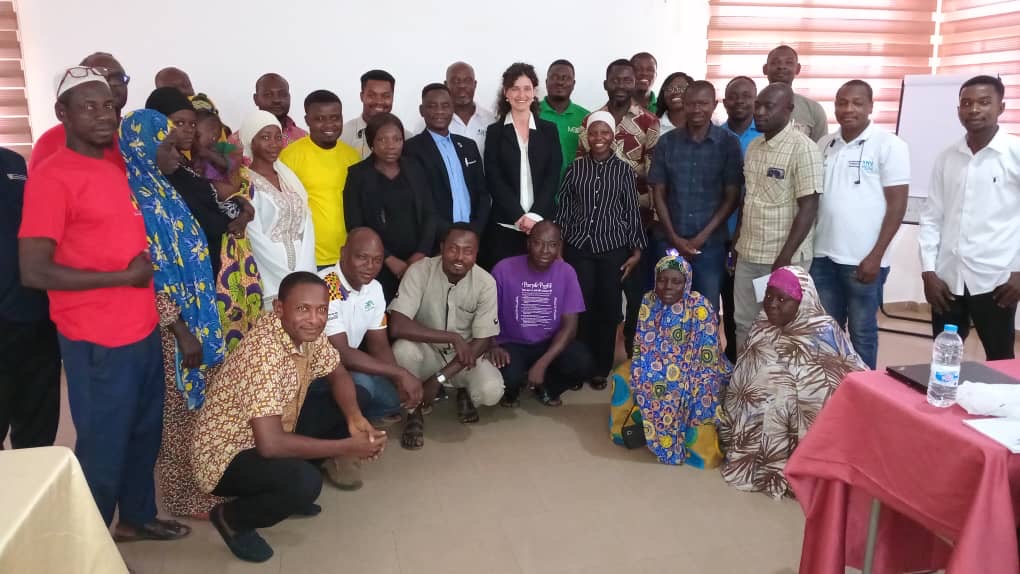
The Earth Kilns are continuously tested and improved in collaboration with local partners Carboneers and Beyond Karbon. atmosfair conducts regular field trials and quality checks to optimise performance and user safety. Monitoring is ensured through moisture measurements, photographic evidence provided by biochar producers, and digital sensors installed in the kilns that track temperature and oxygen levels. This data is then cross-checked in Carboneer’s self-developed digital MRV system, ensuring better process control, emissions tracking, and transparency. atmosfair also leads stakeholder consultations with village leaders, local NGOs, and Ghanaian government representatives to align climate action with national goals. Community feedback plays a central role in shaping how the technology is rolled out.
In parallel, atmosfair is working to align the project with Ghana’s national climate goals and upcoming UN regulations under Article 6 of the Paris Agreement. Coordination with government representatives is underway to ensure long-term compliance and integration into national climate policy.
Certification Standard
There are currently no authorised methodologies under the Clean Development Mechanism (CDM), the Paris Agreement (PACM) or the Gold Standard for calculating carbon sinks through biochar produced in efficient cookstoves. For certification, atmosfair has chosen the Carbon Standard International (CSI), which focusses on the production and incorporation of biochar. Compared to other standards, the calculation of carbon sinks can be considered rather conservative.
Our Partner
Carboneers provides farmers in the Global South with the training, tools and technology to produce biochar. Working with a network of over 33,000 farmers, Carboneers tracks every step of the removal process through its own certified digital MRV system, generating high integrity carbon removal credits that are traceable from field to buyer. Its removals are certified by leading standards including Isometric, Verra and CSI. By putting income, ownership and knowledge directly in the hands of rural communities, Carboneers combines carbon removal with social impact for rural communities.
 Share
Share