
- Home
- Project overview
- Negative emissions
- Cambodia & Vietnam: Biochar-based fertilizers from rice husks
- South Africa: Industrial Biochar and regenerative Fertiliser
- Tanzania: Industrial production of biochar
- Nepal: biochar for the reutilisation of completely depleted soils
- India: Biochar from efficient cooking stoves
- Namibia: Industrial biochar production from encroaching bushes
- Kenya: Direct Air Capture
- Brazil: Enhanced Rock Weathering on citrus orchards
- Ghana: Distributed Biochar Production in Smallholder Farms
- Brazil: Enhanced Rock Weathering on citrus orchards

Brazil: Enhanced Rock Weathering on citrus orchards
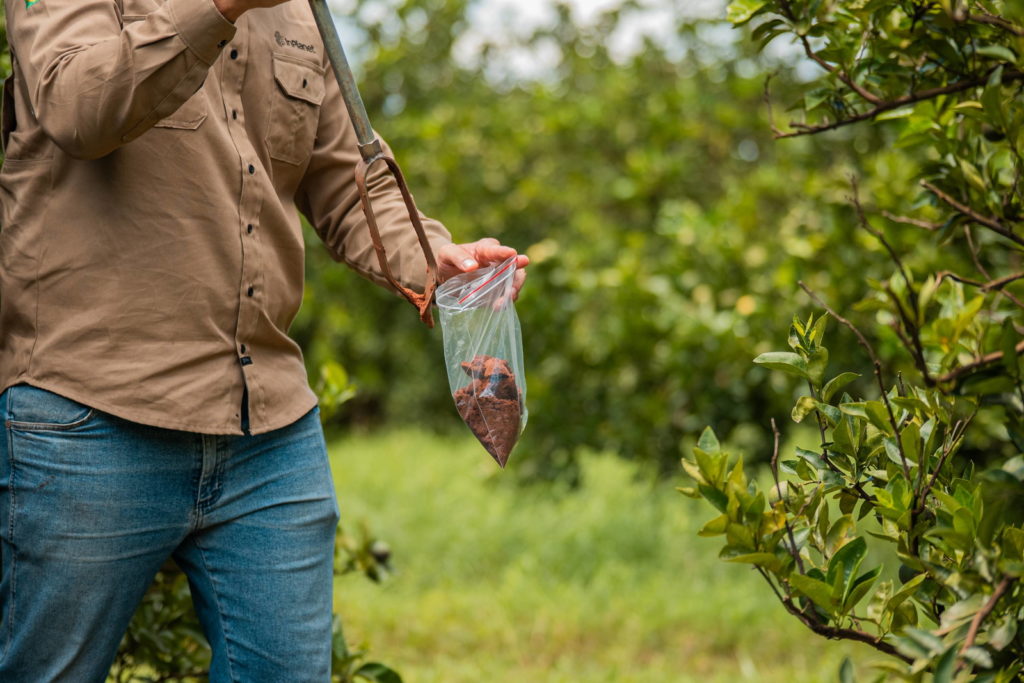
Local farmers working their citrus orchard in Brazil.
Basaltic rock powder sourced locally.
The rock powder is then applied to citrus orchards, where it acts as a remineralizer.
Basalt rock powder increases the resilience of citrus plants.
Summary
| Total savings : | over 500 tonnes CO₂/year |
| Technology transfer : | Enhanced Rock Weathering |
| Local environment : | Application of basaltic rock powder as soil amendment to improve soil quality and promote sustainable practices in the region. |
| Target group : | Local farmers in Brazil |
| Financed by : | atmosfair x InPlanet |
| Project partners : | InPlanet |
atmosfair is partnering with InPlanet to finance an enhanced rock weathering (ERW) project in Brazil. The project removes over 500 tonnes of CO₂ from the atmosphere annually and stores it in the ocean for 1,000+ years through the application of locally sourced basaltic rock powder on citrus orchards in Brazil. The rock powder, sourced from residues of the aggregate industry in Paraná, acts as a natural soil remineralizer. Participating farmers receive subsidized rock powder and implementation support. This enables farmers in the tropics to remove atmospheric CO₂ while regenerating their soils.
Enhanced rock weathering (ERW)
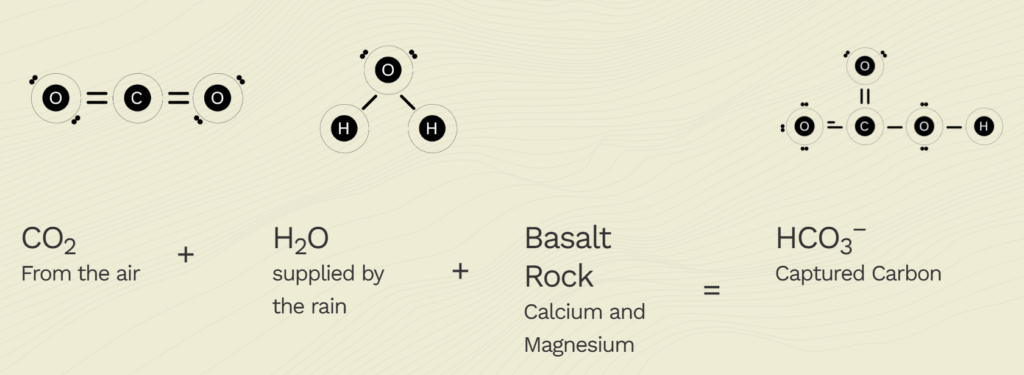
ERW is a novel and pioneering Carbon Dioxide Removal (CDR) technology. Grinding basalt into very fine particles increases its reactive surface area, allowing natural weathering processes to occur much more quickly. In the process, the CO₂ from the air combines with rainwater and then reacts with the basalt powder.
The CO₂ is bound in stable bicarbonates (HCO₃-) and then, transported by rivers into the ocean, where it remains for thousands of years. The natural reactions that geologically bind atmospheric CO₂ and its storage in the ocean ensure low reversal risk, making it one of the most durable CDR solutions.
Brazil’s high temperatures and abundant rainfall naturally accelerate the weathering process. Combined with the local availability of suitable basalt, these conditions make Brazil particularly favourable for enhanced rock weathering.
Basaltic rock powder for plant resilience
Basalt is high in nutrients like calcium, magnesium and trace elements, working as a natural fertilizer. It also balances pH, improves soil structure and increases water retention. Its use as a remineralizer is highly advantageous in tropical, mineral-depleted soils and may reduce the need for conventional fertilisers and agricultural lime. By replenishing essential minerals and improving soil conditions, basaltic rock powder can strengthen plants’ resistance to both biotic and abiotic stresses, helping crops better withstand pests, diseases, and environmental stressors.

The project will use crushed holocrystalline basalt obtained as a by-product of the aggregate industry and classified as a mineral soil enhancer under both Brazilian and European regulations. The feedstock is officially recognized by the Brazilian Ministry of Agriculture, the authority responsible for approving the production, commercialization, and use of agricultural inputs. InPlanet conducts a full characterisation of the rock, and plans its application based on the composition of the rock and soil, to avoid contamination with potentially toxic elements.
Monitoring, Reporting and Verification (MRV) system
To transition ERW from a geological theory to reality, a multi-layered approach to quantify carbon removal with high precision is needed. This project is monitored with InPlanet’s MRV system. This technology is fully functional and integrated into its intended operational environment.
The measurement includes tracking weathering elements such as cations and metals, organic and inorganic carbon products, and secondary measures like pH. The rock powders, soils, soil waters, vegetation, and gases are measured to gain comprehensive insights into weathering processes. The analysis of both solids (the mixture of soil and rock powder) and liquids (soil waters) is necessary to fully understand how much carbon dioxide is being removed. Solid measurements estimate how much rock powder has dissolved based on what remains in the soil. By knowing how much was added, it can be inferred how much CO₂ was removed during the dissolution. This is an indirect measurement approach. By contrast, by looking at the soil waters, the removed carbon dioxide is measured directly as dissolved inorganic carbon. Additionally, the pH or temperature of the water and other important parameters are measured. This approach is the most direct approach to CDR quantification.
Combining these complementary measurements provides a comprehensive picture of the weathering process and the resulting carbon removal. It also allows the project to account for variations in soil properties and environmental conditions.
Our partner
Our partner, InPlanet, is a carbon removal AgTech startup headquartered in Munich and São Paulo. It has emerged as a true market leader by successfully scaling ERW in the tropics, with the vision to sequester gigatonnes of CO₂ while regenerating tropical soils to produce nutritious food and healthy ecosystems for future generations.
 Share
Share