

A pilot project is taking shape: a biogas plant is being built in Colombia that turns urban and agricultural waste into energy while creating value without harming the climate.
It is 7:30 am in Buga, about an hour north of Cali in Colombia: Tobias Hanke has already been up for a while. He has already dropped his children off at school. He continues through the town, which is surrounded by mountains, to the grounds of SENA, a state-run vocational school specialising in agriculture on the outskirts of Buga. The guards at the gate greet him warmly, as everyone is well aware of his dedication.
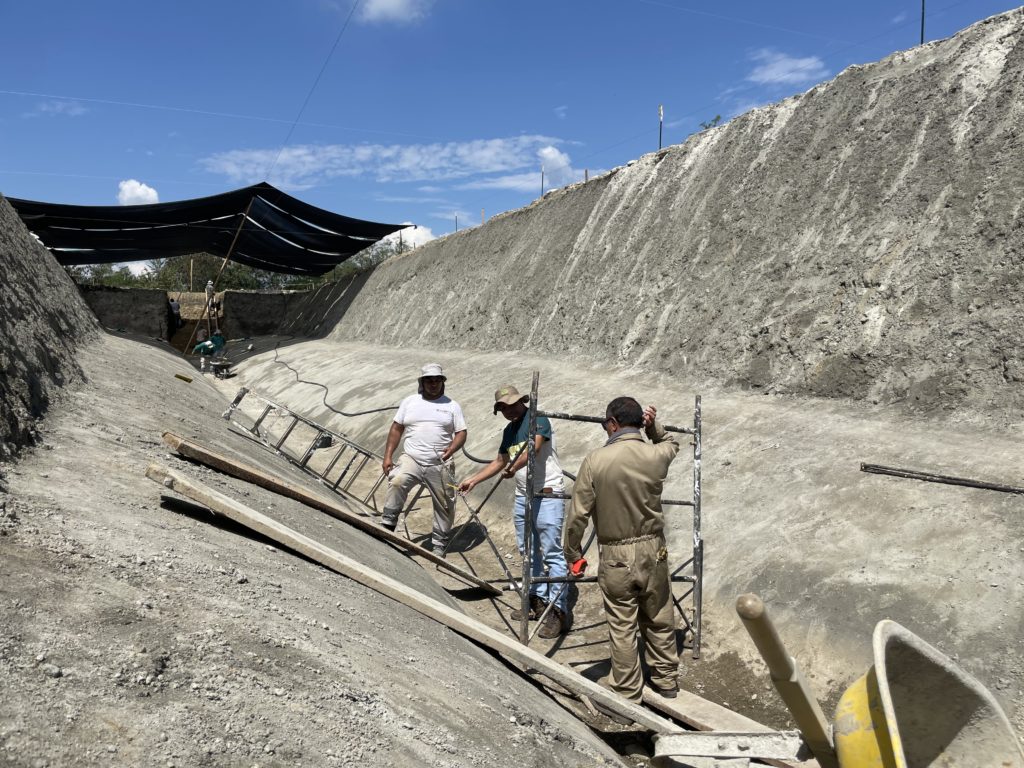
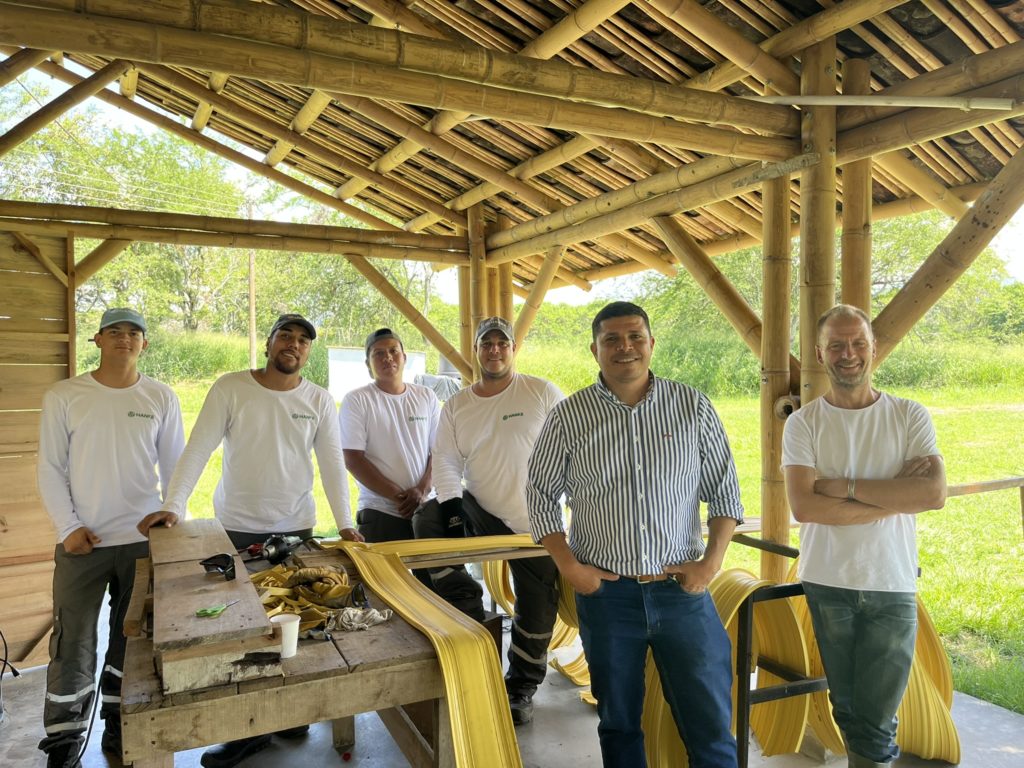
On the SENA site and in close collaboration with the school, Hanke is working on a project near and dear to his heart: the experienced engineer is building a biogas plant here with his company, Hanke S.A.S., and with funding from atmosfair. Hanke has already planned and implemented projects in Germany and Africa; he has been living in Buga for twelve years. After a short drive, he arrives at the construction site. His team is already busy assembling long, yellow sealing strips. These men in white shirts come from the village next door.
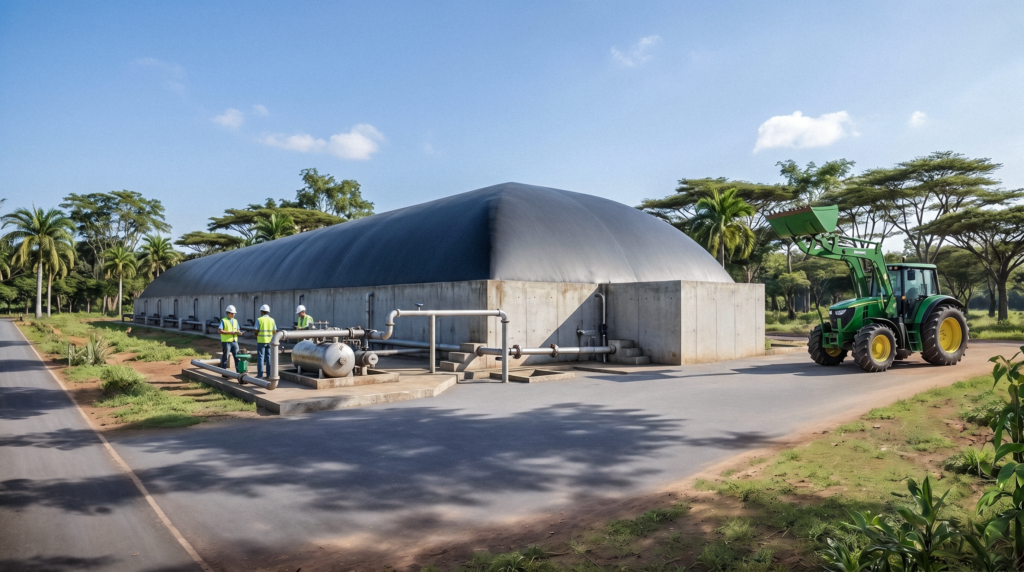
One look at the construction site makes it immediately clear that this biogas plant differs fundamentally from the round plants commonly found in Germany. It is based on a rectangular pit approximately 50 metres long and ten metres wide. Hanke specifically designed the plant to be particularly robust and low-maintenance: “Special spare parts or technical support are almost impossible to get in Colombia because biogas is still a relatively new technology here. That is why I designed the plant so that it does not require a complex mechanical agitator. Instead, the biogas produced is fed back into the liquid biomass, where it provides the necessary agitation.”
Biogas plant
In a biogas plant, microorganisms break down organic matter in the absence of oxygen. This process produces biogas – a mixture consisting mainly of methane and CO₂ – as well as digestate, which can be used as fertiliser. The gas is captured and prevented from escaping into the atmosphere. The energy-rich gas can be used, for example, to generate electricity in a combined heat and power plant or directly as cooking gas.
Methane: a powerful greenhouse gas
Preventing methane emissions is a key aspect of biogas plants. Methane is a greenhouse gas with around 25 times the global warming potential of CO₂ over a 100-year period, and around 80 times the global warming potential over the first 20 years. Reducing methane emissions is therefore crucial not only for meeting long-term climate targets, but also as an extremely effective short-term measure to avoid significantly exceeding the 1.5-degree target.
Furthermore, Hanke has adapted the design to the local climate and the available biomass. Whereas heating or insulation is essential for biogas plants in Germany, neither is required in Colombia. Juan Pablo Llano Castaño, an employee of the regional environmental authority CVC, describes this as the “tropicalisation” of European technology. The authority has drawn up the environmental assessment for the biogas plant, which confirms that it may be built in accordance with local regulations. The CVC also monitors the proper disposal of biomass in the region. Smaller farms in particular have difficulty disposing of their waste properly, as they often lack the financial resources to do so. When stored in open pits, animal manure releases methane into the atmosphere. Juan Pablo therefore sees processing the manure in a biogas plant as a compelling solution.
The biogas project not only helps to reduce agricultural greenhouse gas emissions but also cuts down on urban sources of methane. Right now, the town of Buga’s waste is disposed of at a landfill site. Deep inside the landfill, methane is also produced in the absence of oxygen and released into the atmosphere. Astrid Pulido is the sustainability officer at a local family-run supermarket chain. She reports that large quantities of organic waste from their stores end up at the landfill site every day – ideal “feed” for the biogas plant.
The biogas can be used to generate renewable electricity, while the digestate provides a high-quality organic fertiliser.
Once the plant is up and running, Hanke aims to process around 12 tonnes of organic waste every day. He uses the biogas to produce 2,000 kilowatt-hours of electricity a day, supplying the SENA training centre – where the plant is located – as well as a number of local households. Tobias Hanke is optimistic about the future: “Construction work is coming along well and we have already overcome many obstacles. We will also overcome the remaining bureaucratic hurdles.” The pilot plant will be completed towards the end of 2026 and will gradually begin operations. It will prevent around 2,200 tonnes of CO₂-equivalent methane emissions from landfills and agriculture every year. At the same time, the biogas power plant will save around 300 tonnes of CO₂ by replacing fossil-fuel-based electricity generation. The total climate benefit is therefore 2,500 tonnes of CO₂ – equivalent to the average annual emissions of 250 people living in Germany. Three further plants are set to follow. In future, they will be able to process 145 tonnes of organic residues per day and produce enough electricity to supply SENA and around 1,500 households – a crucial first step towards establishing biogas plants in Colombia.
 Share
Share