

There will be a number of changes to climate action projects in 2026: the United Nations is introducing new rules for carbon offsetting in response to criticism of the previous UN system, the Clean Development Mechanism (CDM). The new Paris Agreement Crediting Mechanism (PACM) is designed to address the shortcomings of the CDM. We welcome the fact that the PACM relies on methods that tend to underestimate rather than overestimate the impact of climate action projects. This helps prevent “hot air” and greenwashing.
Of particular importance here is the principle of additionality, which has often been inadequately implemented within the CDM framework. One example can be found in India, where donors from the Global North funded wind farms and received certified CO₂ reductions in return. However, a closer look revealed that, during the same period and in the same regions, profitable wind farms were also being built without any climate finance. This meant that many of the subsidised wind farms – despite being registered under the CDM – were in fact not additional, as they would have been built even without climate finance. To address this, the new PACM requires a thorough assessment of whether the technologies in question have already reached market maturity or are receiving state subsidies.
Dynamic baselines prevent overestimation
There have also been improvements to the so-called baselines, which describe how much greenhouse gas would be emitted in the absence of the climate action project under review. This value is used as the basis for calculating how much CO₂ a project has actually saved. However, there are differing estimates for such baselines. The PACM now stipulates that, in cases of doubt, the lowest scenario should be chosen as the reference. As a result, the impact of projects is more likely to be underestimated than overestimated. One example is the fraction of non-renewable biomass (fNRB). This describes the proportion of harvested firewood in a given region that does not regrow and therefore contributes to CO₂ emissions. Previous figures were often set too high, meaning that the CO₂ reductions achieved by efficient stoves were frequently overestimated. In response, the PACM reform is now adjusting the fNRB values.
Baselines may change over time if, for example, technological progress leads to a reduction in greenhouse gas emissions even without climate finance. Under the CDM, baselines were kept constant for many years, which is why they did not reflect such progress. This had particularly absurd consequences in the case of CO₂ credits for the destruction of the industrial waste gas trifluoromethane (HFC-23). Here, a constant baseline created incentives for companies to produce HFC-23 unnecessarily, because its subsequent destruction was lucrative. The new PACM system instead uses dynamic baselines that can be adjusted to reflect new circumstances.
PACM rules provide additional climate action and prevent double counting
The new rules not only improve climate action but also create new opportunities for people in the Global South. For example, local stakeholders now have the opportunity to lodge complaints throughout the entire duration of a project. Climate action projects must not only reduce CO₂ emissions but also take into account the United Nations’ Sustainable Development Goals (SDGs). These include, among other things, combating hunger, promoting health, empowering women, and improving the incomes of people in rural areas.
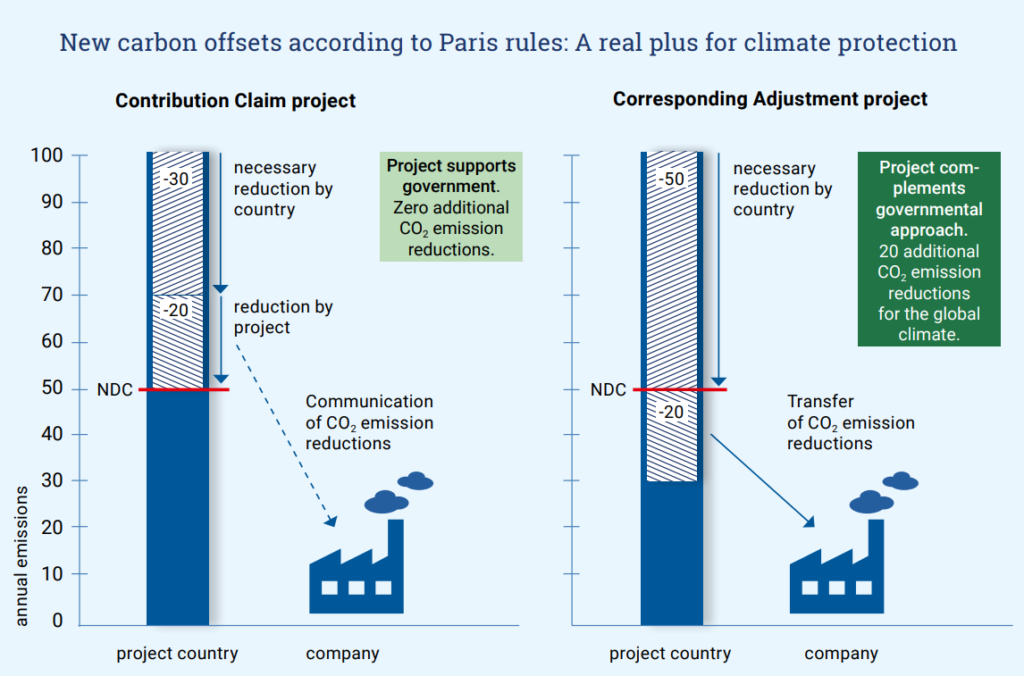
Finally, Corresponding Adjustments (CAs) can significantly improve the quality of projects even further. Under this scheme, a project country does not count a project’s CO₂ mitigations towards its own climate target but instead transfers these reductions to the project’s foreign investor.
Through CAs, the previous zero-sum game of voluntary CO₂ offsetting by, for example, European companies is transformed into additional emission reductions for the climate. This is because – as described – the project countries can neither count the project’s CO₂ reductions towards their own targets, nor can investing companies from Europe do so, as long as they use the projects for voluntary CO₂ offsetting of their remaining residual emissions. Neither the project country nor the companies can therefore count the CO₂ reductions towards achieving their legally mandated climate targets. Physically, however, these CO₂ reductions do take place, and they are certified by the UN. As a result, they benefit the global climate, as they occur in addition to global CO₂ reduction obligations and no party is permitted to count them towards their own targets.
Together with the PACM’s stricter criteria, these additional climate action measures should help restore confidence in carbon offsetting. As a result, following a decline in market volume between 2021 and 2024, the voluntary carbon market now has the opportunity to grow again.
 Share
Share