

• Large quantities of waste from agriculture and forestry in the Global South remain unused.
• Usable for green electricity, biochar as carbon storage, or for synthetic fuel covering 20% of global aviation demand.
• New method with comprehensive environmental and social sustainability criteria based on UN Sustainable Development Goals.
Residues from agriculture, forestry, and wastewater treatment can serve as energy and carbon sources, making a significant contribution to climate protection while simultaneously contributing to economic and social development in Global South countries. This could cover approximately 20 percent of global aviation’s fuel demand synthetically from such residual biomass, all while maintaining the highest environmental and social sustainability standards, according to a study by the climate protection organization atmosfair and the ifeu Institute for Energy and Environmental Research, presented today in Berlin.
“Biomass for energy production is often problematic: deforestation, energy corn, food-versus-fuel conflict, soil depletion, and harm to smallholder farmers. We wanted to know how much remains for climate protection if we exclude all of that,” says atmosfair CEO and study co-author Dietrich Brockhagen. “Our study shows that there are large quantities of residual biomass locally and regionally in developing countries that can be used for climate protection and economic development. Investments in this area contribute to technology transfer and climate justice.”
Restrictive Approach with Far-Reaching Criteria
The study calculates the potential of residual biomass from agriculture, forestry, and wastewater treatment in 111 Global South countries that would be available for electricity production, carbon-neutral jet fuel, or permanent carbon storage in soil if comprehensive environmental and social sustainability criteria are applied. These newly developed criteria are a central component of the study and go further than previous studies. They are based on the UN Sustainable Development Goals as well as current data on agricultural and timber production and wastewater treatment.
“The atmosfair study applies extremely restrictive criteria. It identifies potential sources that are reliably sustainable and harmless. On this basis, Global South countries can themselves build value chains for a global market,” says Horst Fehrenbach from the ifeu Institute, who provided scientific guidance for the study.
For example, grain residues are excluded if they belong back on the fields as part of an ecosystem to maintain soil carbon content. Residues from energy crops such as oil palms, as well as soy and corn from animal feed production, are unsuitable, as are wood residues from plantation forests. The question of what would otherwise happen to the residues is also important, as the biomass is often already being used meaningfully for textiles or animal husbandry. Additionally, production must meet a series of social standards (human rights, occupational safety, protection of smallholder farmers).
“Residual biomass in the Global South has great potential, even if, as the atmosfair study does, particularly strict sustainability criteria are applied. This potential is sufficient and ideally suited as a bridging solution to electricity-based power and raw materials. The study is an important contribution; it validates and enriches our approaches to defossilising the economy,” says Torsten Schwab, Director of Technology at GIZ’s International Power-to-X Hub.
Basis for Carbon-Neutral Electricity and Jet Fuel Production
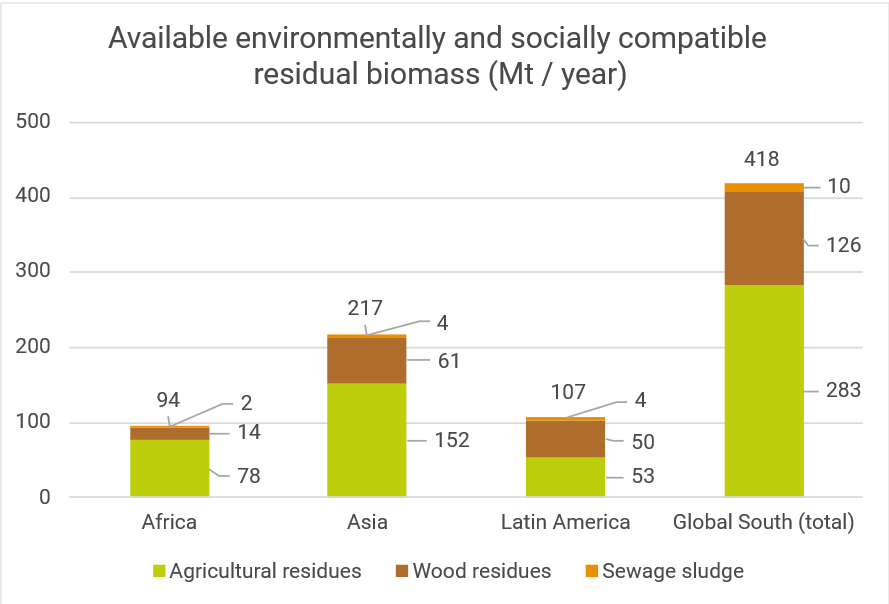
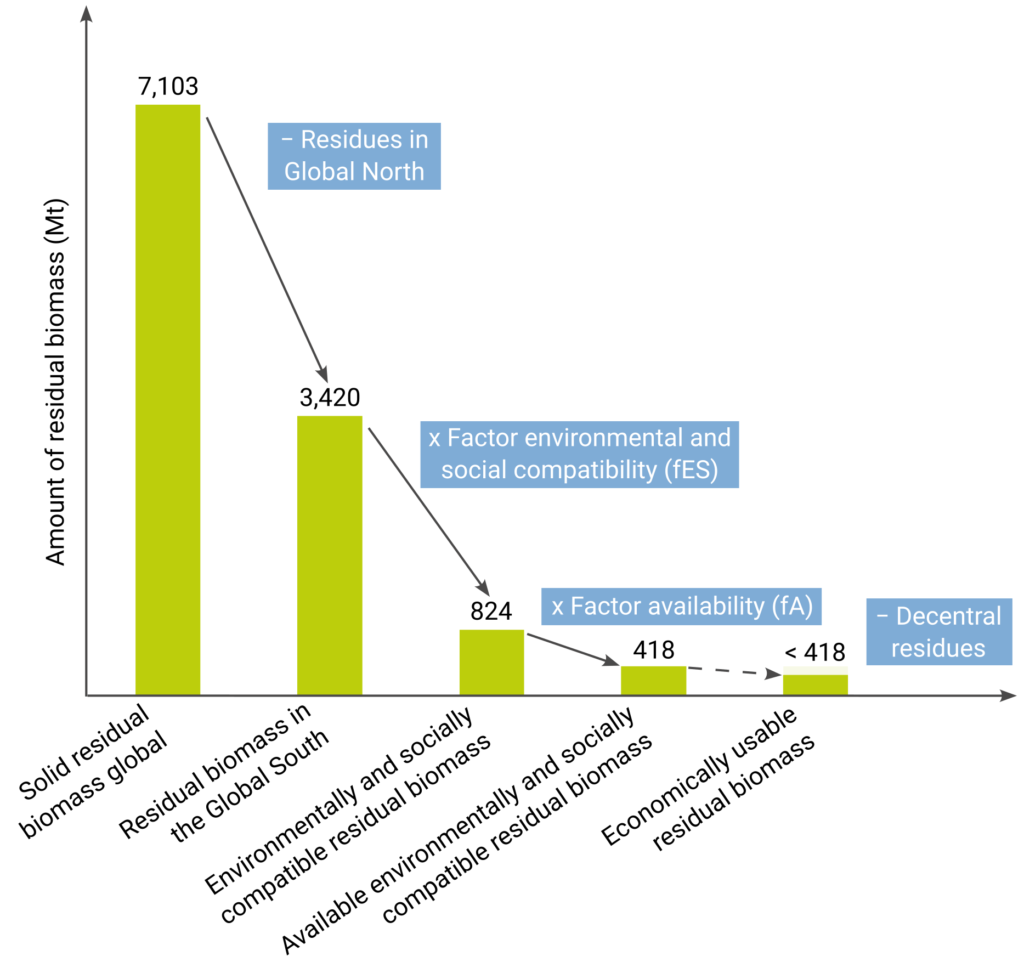
According to the study, of the approximately 3.4 billion tons of residual biomass produced annually in Global South countries, around 400 million tons can be used in socially and environmentally sustainable ways. This quantity could produce, for example, 40 million tons of jet fuel through gasification, equivalent to roughly 20 percent of global aviation’s 2022 demand. This is a different approach from bio-jet-fuel, which is predominantly produced from specially cultivated oil-bearing plants.
Local electricity production or valuable biochar, which improves soil and stores carbon, are also effective climate protection applications. The biomass residues could generate 645 terawatt-hours of electricity in biomass power plants or 125 million tons of biochar, which would permanently bind 350 million tons of CO₂ in soil. This corresponds to nearly one percent of global CO₂ emissions. All three cases would promote economic and social development through new jobs and access to clean energy.
Great Potential for Climate Protection Projects
“Many crop and wood residues in the Global South simply rot or are even burned, polluting the air. These are at the center of our study, which shows how we can use them to generate climate-friendly energy or permanently store carbon in soil with benefits for crops,” says Wolfdietrich Peiker from atmosfair, also a co-author of the study.
Since plants remove CO₂ from the atmosphere during their growth phase, and since the carbon in sewage sludge ultimately comes from plant production, the use of residual biomass is carbon-neutral or can even remove CO₂ from the atmosphere.
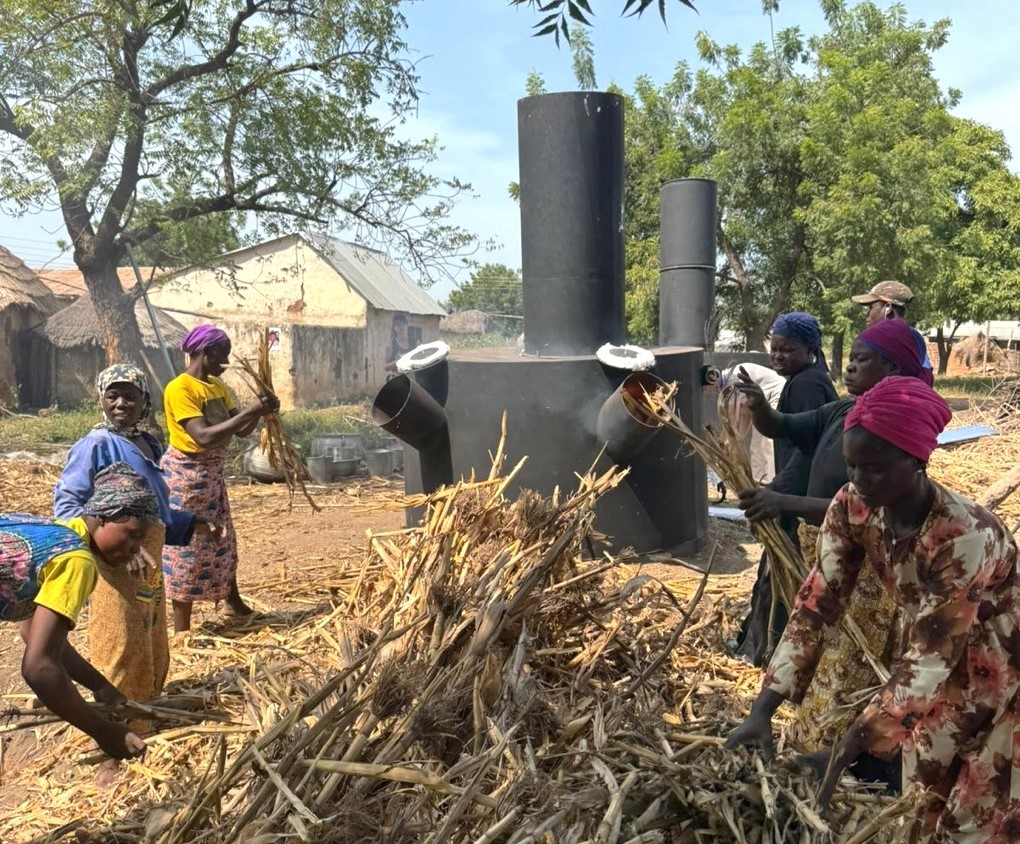
atmosfair is already actively using residual biomass for climate protection today. In Ghana, the climate protection organization provides pyrolysis systems that enable women farmers to produce biochar from their crop residues. This biochar improves soils and permanently binds CO₂ in the ground. In Tonk, India, mustard straw is used for electricity production, and in Malawi, atmosfair uses waste from rice and tea production for climate-friendly brick manufacturing.
Methodology: Step-by-Step Reduction of Unsuitable Residual Biomass
The study combines a top-down with a bottom-up approach. In the top-down approach, it derives 11 criteria from the United Nations Sustainable Development Goals (SDGs), which include the exclusion of energy crops, environmentally sustainable agriculture, and protection of smallholder structures. In the subsequent bottom-up approach, the study applies these criteria to different residual biomasses in Global South countries. This excludes both quantities that are not environmentally and socially sustainable as well as residues already being used as animal feed, soil improvers, or as energy sources by smallholder populations. The study uses data from the United Nations Food and Agriculture Organization (FAO), self-conducted expert interviews, and external studies as its foundation.
Find the full study here.
 Share
Share