

When it comes to the climate impact of air travel, the focus is usually on CO₂ emissions. In fact, however, around two-thirds of the climate impact of flying is attributable to contrails, and these could be avoided relatively easily. In this article, we explain what researchers and the aviation industry have discovered through test flights, and what policymakers can do.
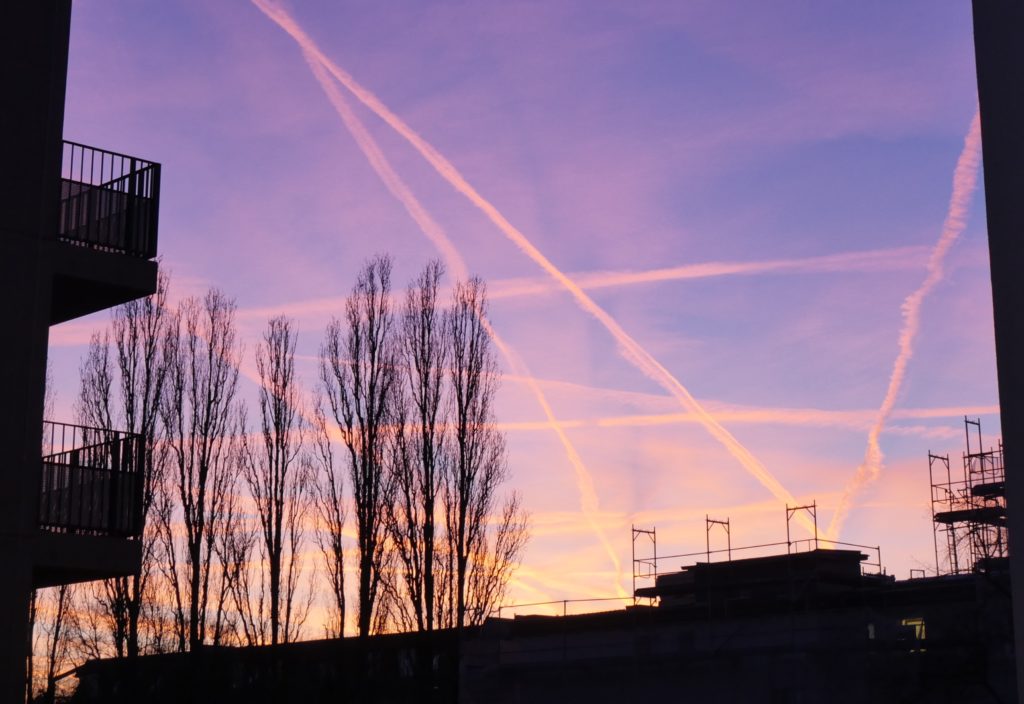
In Europe, it is a familiar sight: bright bands criss-cross the evening sky, later transforming into thin veils in the air. Sometimes they form pretty patterns; at other times, reddish-yellow, ominous portents on the horizon. Contrails from airplanes are ubiquitous in Europe’s busy airspace, and they have a massive impact on the climate. Depending on the time frame, they account for two-thirds of the total greenhouse effect caused by air traffic.
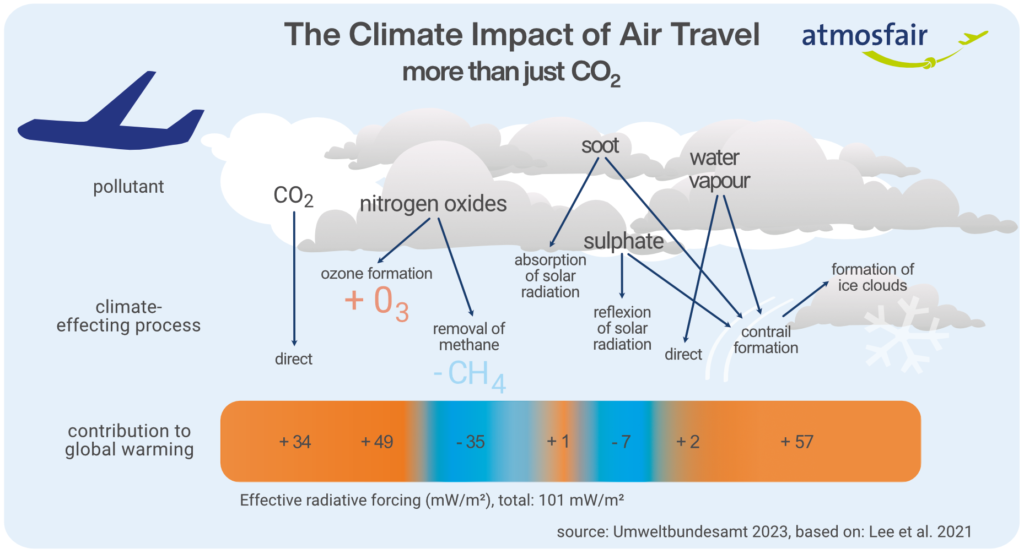
This effect has been known for almost 30 years: contrails and other aircraft emissions act like an insulation layer, reflecting back heat radiation emitted from the earth’s surface. Even though the contrails from a flight disappear after just a few hours, they contribute more to global warming than the CO₂ emissions from the same flight, even though CO₂ molecules remain in the atmosphere for 100 years or more.
How contrails emerge
An aircraft engine emits not only CO₂ but also other climate-impacting substances such as nitrogen oxides, water vapour, and soot particles. The latter act as condensation nuclei for contrails. At a cruising altitude of ten kilometres, air temperatures range from minus 40 to minus 60 degrees Celsius. There, the water vapour freezes and attaches itself to the soot particles. As a result, the aircraft leaves a trail of increasingly thick streaks in its wake. In some cases, these trails remain in the sky for many hours, developing into extensive, veil-like cirrus clouds. However, this doesn’t always happen:
- If the air surrounding the aircraft is dry, it has sufficient capacity to absorb the water vapour from the engine. In that case, condensation does not occur.
- When an aircraft is flying through layers of air with higher temperatures, ice crystals form less frequently because warmer air can hold more water.
Long-lasting contrails form primarily in areas with low temperatures and high humidity. Scientists refer to these areas as Ice Supersaturated Regions (ISSRs) or Regions with Potential for Persistent Contrails (PPC regions). These areas occur mainly at night and in winter, as well as in specific regions such as over the North Atlantic. Aircraft should avoid these areas to minimise their overall impact on the climate – even if the resulting route takes a little more time and kerosene. The good news is that surprisingly few flights are affected by this.
A small number of flights cause the majority of contrails
A recent study by the Copernicus Climate Change Service revealed the following findings:
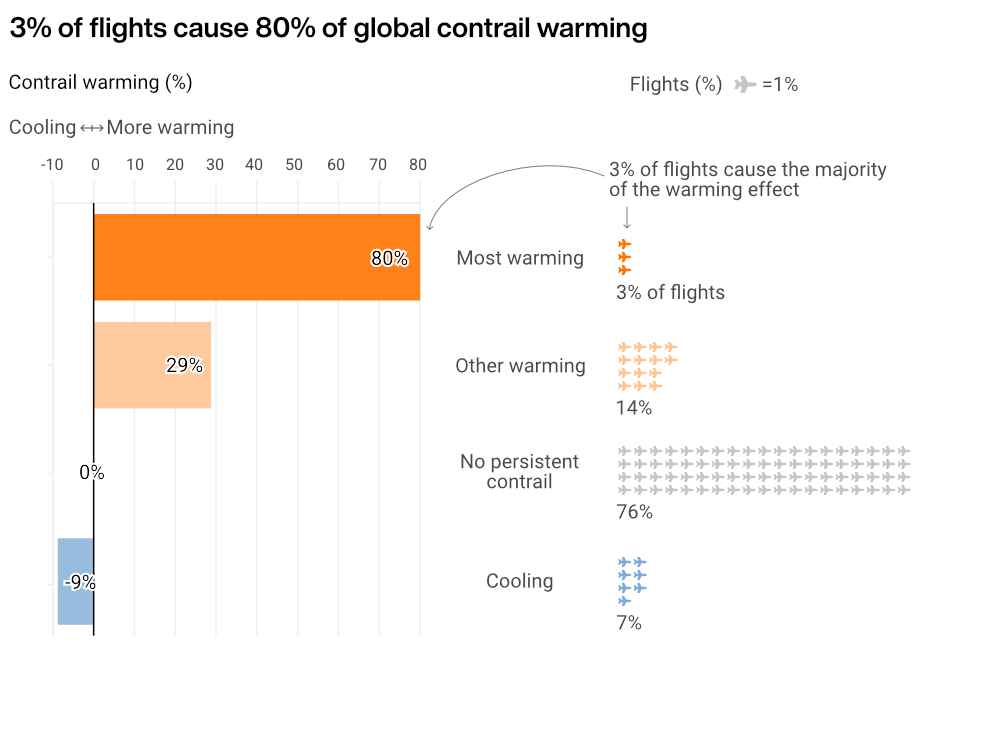
- Condensation trails are caused by only a quarter of all flights.
- In 30 per cent of all flights that cause condensation trails, these actually have a cooling effect. This is because the trails reflect more sunlight back into space than heat back to earth. This is particularly the case in the morning hours.
- Even for flights with warming contrails, the climate impact varies significantly: a mere three per cent of all flights worldwide are responsible for 80 per cent of the global warming caused by contrails.
Therefore, there is high potential for making travel more climate-friendly: only a small number of flights would require airlines, pilots, and air traffic control to adjust their route planning to avoid these particularly cold and humid areas. ISSRs can cover areas several hundred kilometres in diameter but are usually only about one kilometre thick, extending up to two kilometres at their edges. To avoid them, pilots would, in most cases, need to change their altitude for a short period. In many cases, a few hundred metres would suffice, according to experiments conducted by the German Aerospace Centre (DLR) and EUROCONTROL.
Although aircraft burn slightly more kerosene when climbing and when flying at lower altitude with higher air resistance, and thus emit slightly higher CO₂ emissions, the overall climate impact of the flight would be significantly lower due to the avoidance of contrails. For airlines, kerosene is a major cost factor. This is why they prefer to avoid such detours. However, according to a study in Evironmental Research, aircraft fleets would need only 0.11 per cent more kerosene to avoid 72 per cent of the greenhouse effect caused by their contrails.
What is the government doing to encourage the rerouting of flights?
To create incentives for avoiding contrails, the European Commission is considering including non-CO₂ effects in the ETS in the future. Since 2012, this system has required to purchase allowances for CO₂ emissions from flights within the European Economic Area (EEA). Then, since 2025, the EU requires airlines to collect and report data on non-CO₂ effects from their intra-European flights in order to improve scientific understanding.
After three years of data collection, in 2028, the European Commission intends to decide whether, and in what form, non-CO₂ effects should become part of ETS trading. Pricing for contrails is preferable to the current situation: at present, warming contrails are not subject to the polluter pays principle, and there are no price signals reflecting the environmental costs of contrails in aviation. However, the pricing mechanism of non-CO₂ effects must be carefully considered. For instance, it would be risky to convert non-CO₂ effects into CO₂ equivalents and include these directly in emissions trading from a methodological point of view. As an alternative, a separate levy for non-CO₂ effects, or even overflight charges that depend on the risk of contrail formation, are under discussion.
If pricing is the sole regulatory instrument, there is a risk that airlines will pass on the cost of ETS allowances for the few flights producing particularly harmful contrails to their entire fleet, rather than adjusting their flight planning. In that case, climate-warming contrails would be priced but not avoided.
For this reason, supplementary or alternative regulatory measures are being discussed alongside pricing, such as air traffic control closing off PPC areas where flight volumes permit. These measures could be tested in the transatlantic corridor, which sees both a high volume of flights and a particularly high incidence of contrails.
Climate protection at a bargain price
Contrary to aviation industry’s statements, the additional financial cost of rerouting would be minimal. According to an estimate by Transport & Environment, it would cost twenty euros to avoid one tonne of CO₂ equivalent by rerouting around ISSRs. Building wind farms and solar panels to achieve the same reduction would be three times as expensive. And direct air capture (DAC) of the same amount of carbon dioxide would cost as much as 360 euros per tonne.
Transport & Environment estimates that rerouting will add 1.20 euros to the cost of a ticket for a flight from Berlin to Barcelona—and this applies only to the few flights whose route needs to be adjusted. The price for the Paris–New York route would rise by 3.90 euros, which is significantly less than a coffee at the airport. However, flight routes should be strategically planned before take-off to avoid PPC areas. According to a research project by the Federal Ministry for Economic Affairs involving 100 test flights, this would be less costly than changing routes during the flight. Such a tactical adjustment would also reduce airspace capacity by half.
Climate-optimised route planning is therefore a feasible measure that can have a significant impact in the fight against climate change, even in the short term. It is now up to regulators to finally implement it, and up to airlines to support this with all their expertise. The short-term goal must be to collect as much data as possible under which circumstances aircraft successfully avoid contrails. This data provides the necessary foundation for avoiding as many non-CO₂ effects as possible in the medium and long term, or at least for pricing (and offsetting) them.
 Share
Share