


atmosfair news February 2026
Dear Readers
The first few weeks of 2026 were eventful. For the first time, atmosfair defended itself against false statements published in a newspaper – specifically DIE WELT. This led to court proceedings in February, in a case between atmosfair and the Axel Springer publishing house.
There appears to be a consensus among observers that climate policy is only a relatively minor target under the Trump administration in the United States. But where does the EU stand? Many are speaking of a rollback, pointing to the weakening of the planned phase-out of combustion engines from 2035 and the postponement of climate reporting obligations for the vast majority of European companies. At the end of 2025, there was extensive debate about the European climate protection target for 2040. In our view, however, the goal of reducing CO₂ emissions by 90 % compared to 1990 still provides a solid foundation, even if its implementation includes some softening measures.
Given the weakening economy in Germany and the EU, as well as the major challenges posed by the United States and China, it is understandable that many citizens in the EU are currently reluctant to advance climate policy at the expense of the economy, even though this perceived contradiction does not exist in many areas. According to the Federal Environment Agency, the proportion of people in Germany who consider climate protection to be very important has steadily declined in recent years. Support in Germany for the goal of limiting global warming to well below two degrees Celsius is also diminishing. The EU’s decisions for 2040 are therefore subject to the condition that energy prices and competitiveness are regularly assessed through a review mechanism, allowing the climate law to be adjusted if necessary.
It is therefore not surprising that climate policy has once again become the subject of increasingly controversial debate in the mainstream press as well as on social media. At the same time, unfair attacks are on the rise. At the end of 2025, the organisation LobbyControl published a report entitled „Desinformation, Diffamierung und Defunding: Zivilgesellschaft unter Druck“ (“Disinformation, defamation and defunding: civil society under pressure”), which shows how media attacks target environmental NGOs. A prominent example is a series of articles published in DIE WELT. Under the headline “Secret contracts – EU Commission paid activists for climate lobbying”, the WELT editorial team claimed, among other things, that the EU Commission had stipulated in “secret contracts” that NGOs should torpedo coal power and trade agreements. It further alleged that the EU Commission had paid substantial sums of money to NGOs for this purpose. The Süddeutsche Zeitung, DIE ZEIT, and Politico corrected these allegations. DIE WELT was reprimanded by the German Press Council shortly before Christmas 2025.
This has been happening on social media for quite some time. It is already well known that extreme opinions tend to dominate discourse on Facebook and other platforms. Shielded by anonymity, commentators often speak more freely than they would dare to in a face-to-face conversation. However, author Max Fisher has shown that Facebook’s own algorithm actively promotes these extremes by pushing moderate posts far down the page, thereby contributing to violence and chaos. This dynamic keeps users on the platform longer, allowing more revenue to be generated from advertising.
atmosfair wins against Axel Springer Verlag
The Free and Hanseatic City of Hamburg had set itself the goal of reducing CO₂ emissions by 2 million tonnes by the end of 2020. Because its own climate protection measures were insufficient to achieve this target, it funded a total of 75,000 tonnes of CO₂ offsetting through atmosfair, based on a project involving efficient stoves in northern Nigeria. Audit reports by UN-accredited auditors – freely available on the website of the UN Framework Convention on Climate Change (UNFCCC) – showed that atmosfair had distributed more than 11,000 of such stoves in Nigeria. Over several years, these stoves successfully saved the documented amount of CO₂, as verified and recorded by the auditors.
Nevertheless, on 18 December 2025, DIE WELT published an article under the headline “How Hamburg bought stoves in Nigeria that never existed” and the subheading “To achieve its climate targets, Hamburg financed climate-friendly stoves in Africa – but they were nowhere to be found.” The article claimed: “The efficient stoves the Senate used to polished up its climate balance sheet from 2018 onwards only existed on paper.” It went on to ask: “Were savings credited here that were based solely on the principle of hope?”
This was a new experience for atmosfair. CO₂ offsetting has, of course, often been – and continues to be – subject to critical scrutiny, which is ultimately part of the press’s role. In addition to the official UN-accredited auditors, Stiftung Warentest and various scientists have also examined and evaluated our projects and publications in detail. However, never before have essential facts been misrepresented in a way that undermines confidence in our projects.
In two proceedings for injunctive relief and counterstatement, atmosfair sued the Axel Springer publishing house before the regional court and the court of appeal in Berlin at the end of January respective the beginning of February 2026 – and won. The judges upheld all points of atmosfair’s lawsuit. DIE WELT is no longer permitted to use the false statements mentioned above and must publish a corresponding counterstatement in the same place.
Air traffic: new study in Nature Communications
In January, the journal Nature Communications Earth & Environment published a scientific paper on the CO₂ savings potential in global air traffic, authored by a team led by Stefan Gössling. atmosfair contributed the CO₂ calculations for aircraft and the associated data. The study found that air traffic could already reduce CO₂ emissions by over 50 % per flight kilometre today if state-of-the-art aircraft were used, with only economy seating and the highest possible load factors.
In an interview with atmosfair, the TAZ newspaper asked what politicians could realistically achieve based on these theoretical potentials. Read the article here.
Joint biomass study with the ifeu Institute
At the end of 2025, we presented a new atmosfair study, supported and published by the ifeu Institute. Our initial question was: How much of the world’s residual biomass is truly sustainably available – meaning it can be used for energy without harming the soil or forests and without competing with small-scale farming, such as for livestock bedding? Our study goes a significant step further than previous research, which mostly focused only on the distinction between specially cultivated energy crops, such as rapeseed, soy, or palm oil, and residual biomass produced as waste when grain is threshed, fruit is pressed, or wood is sawn.
The study focuses on developing countries. We show that there is still considerable potential to be tapped, which could, for example, replace 20 % of the fossil kerosene used in global air traffic with synthetic kerosene produced from the gasification of such biomass.
I hope you enjoy reading!
Kind regards,
Dietrich Brockhagen
Managing Director, atmosfair
P.S.: atmosfair is growing and looking for passionate people with technical backgrounds to join our global climate projects. Interested? You can find our current job openings at atmosfair and Solarbelt here.
New study: CO₂ efficiency of flights could be doubled

Flying emits more greenhouse gases in a short period of time than any other human activity. However, the CO₂ efficiency of air travel could theoretically be increased. An international team of researchers analysed data from atmosfair – and discovered big potential.
atmosfair study: 400 million tonnes of residual biomass for climate protection
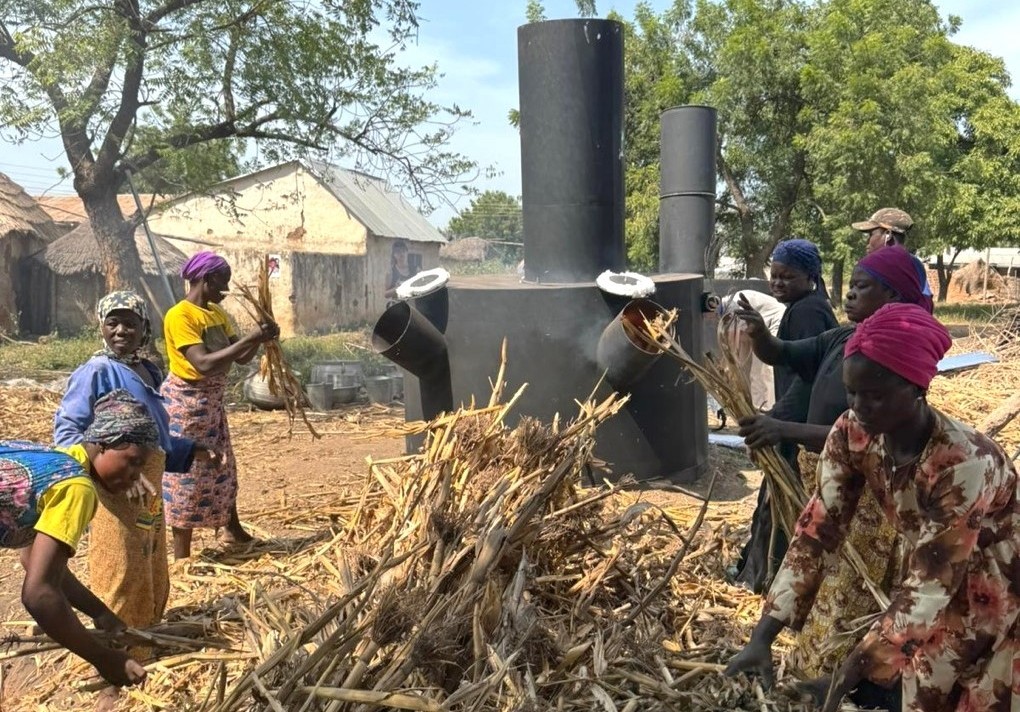
Wheat straw, wood chips, sewage sludge – countries in the Global South produce large quantities of organic waste that has previously been left to rot or burned. How many tonnes of this waste could be used for climate protection? atmosfair answered this question in a large-scale study.
3,500 school lessons for climate protection
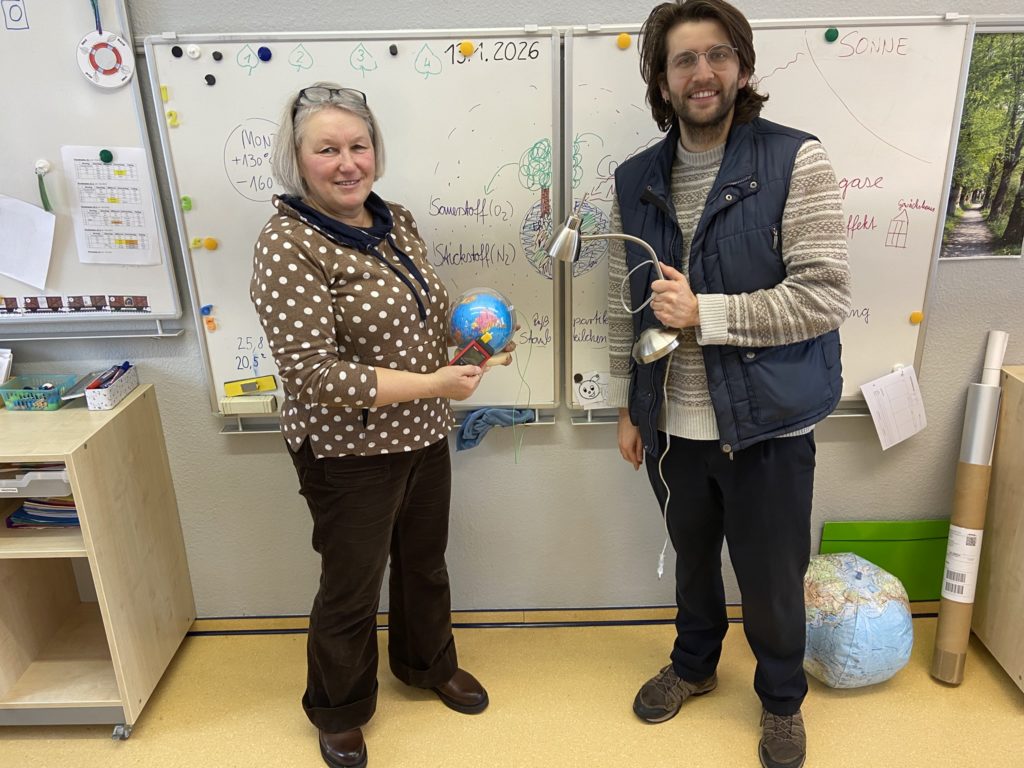
In recent years, pupils at more than a thousand primary schools have learned how to avoid CO₂ emissions. atmosfair developed these teaching modules for Deutsche Umwelt-Aktion (DUA), which teaches at schools. One aspect never fails to impress the children.
 Share
Share